top of page

Linkol AI: The "Price Discovery" Engine for Web3

TEAM
VaporAviator Design Studio
ROLE
Product Designer
(Strategy, UI/UX, Systems Architecture)
TIMELINE
Summer 2025
Long Story Short
Translating raw social engagement into verifiable on-chain assets. Empowering individual creators to own and monetize their digital influence.
Impact
+30% User Activity
Successfully pitched a strategic pivot to a B2C "Tweet-to-Earn" model
-40% Dev Friction
Spearheaded a tokenized design system and modular "UI Bricks" to eliminate ambiguity in engineering hand-offs
2X Faster Delivery
Accelerated the overall design-to-development timeline by integrating an AI-augmented collaborative workflow
How did one strategic pivot boost our post-launch activity by 30%?
The Strategic Pivot: Listening to the Market
Assumption
Reality Testing
Pivot
Product focused on a B2B model—matching enterprise Web3 projects with top-tier KOLs
Onboarding high-profile KOLs and enterprise clients carried immense friction and unsustainable acquisition costs.
Shift to a democratized "Tweet-to-Earn" model for grassroots Twitter users.
The Evolution: Before vs. After
BEFORE
B2B matchmaker
Problem
Traditional matchmaking with elite KOLs is slow, expensive, and carries massive dual-sided onboarding friction.
Goal
Connect enterprise Web3 projects with top-tier KOLs for targeted marketing campaigns.
Solution
Complex data leaderboards, heavy KOL ranking systems, and manual outreach tools.
AFTER
Democratized Ecosystem
High user acquisition costs and the steep learning curve of "Web3-native" tools block early-stage product growth.
Spark organic, viral community growth by building a frictionless, "Web2-like" onboarding experience.
A "Tweet-to-Earn" system. Projects deposit marketing fees directly; any user can link their X account, post, and automatically earn USDC via a smart-contract raffle loop.
Core Question
How might we
shift from high-friction B2B matchmaking to a democratized platform that empowers everyday Twitter users to onboard and monetize?
Final Outcome


Responsive Adaptations: Trading & Agent


Scalable Ecosystem: From Desktop to Mobile

Market Positioning & Competitor Analysis
Design Development

Four.meme
Analyzed as a core competitor for its "Create Token" flows and the way it handles social/meme-centric UI components.

Coinbase
Studied to understand the onboarding flow for new crypto users, specifically looking at how they simplify wallet setup and transaction histories.

Coinmarketcap
Analyzed for its data visualization of "Market Stats" and "Top Trending" lists, which influenced how we presented the Linkol "Value Ranking" and asset performance.
Design Development
The Iterative Engine

Typography
A clear hierarchy using the Inter family, led by 48px BOLD headers for major landing sections.

Color Key
A blue-based palette centered on #007AFF, utilizing varying opacities for tags and background elements to create depth without visual clutter.
AI-Augmented Collaboration

AI-generated Vibe Coding
From "Vibe" to Visualization
I utilized AI-powered "vibe coding" tools to generate raw page layouts that captured the "feel" and basic functional requirements of the product.
Eliminating Ambiguity
Instead of relying on abstract verbal descriptions that often lead to misinterpretation, the clients provided these AI-generated frames alongside detailed documentation for every meeting, making their needs immediately tangible.
The Human-in-the-Loop: Polishing and Tailoring
The Designer as Curator: While the AI could generate a "vibe," it often failed to produce the exact logic or technical accuracy required for the final product.
Rapid Translation: I acted as the critical human link, rapidly grasping the core intent of these raw layouts and asking targeted follow-up questions to refine the "vibe" into a polished, logical UI that aligned with our development progress.
Iterating Wisely: By bypassing the "blank canvas" stage, I was able to focus my energy on high-value design tasks—such as perfecting the service flow and ensuring the dual needs of businesses and creators were met—rather than basic layout exploration.
Synchronous Efficiency with Figma

Figma Workplace
Real-Time Collaboration
To maintain total transparency, I integrated my refined work into shared Figma files immediately upon completion.
Contextual Feedback
This allowed clients and team members to work synchronically, leaving comments directly on the specific UI components, which significantly reduced the feedback loop and ensured every iteration moved the project forward.
Core Platform Features
Looking for KOLs


Phase 1: Translating the Fundament
Initial Prototype
I began by creating the first high-fidelity prototype directly from the project's inherited wireframes.
Establishing the "Bricks"
During this stage, I established the core UI components—the evaluation cards, search bars, and filtering sidebars—using our Inter typography and #007AFF color system.

Phase 2: Data-Driven Refinement
Rapid Adaptation
Because I had built the first version using a modular "brick" system, I was able to quickly adapt these existing components into the refined layout.
Second Wireframe
After initial feedback and alignment with the agent’s business goals, a second, more refined wireframe was developed to improve the information hierarchy.

The Final Version
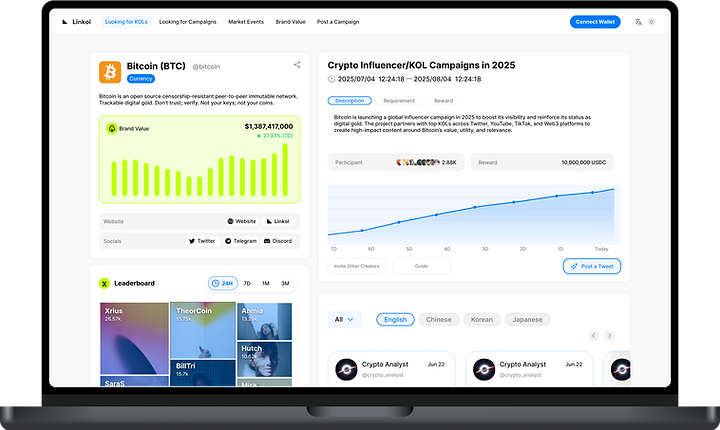
Brand Value

Initial State
The "vibe coding" layouts provided a basic concept of "Branding Value" but lacked a distinct, shareable visual identity.
Visual Polish
The final version utilizes your established color key to make complex data look clean and trustworthy. It also incorporates the Tweet Value Card, which acts as the definitive "shareable" asset of the brand value experience.
Final Version

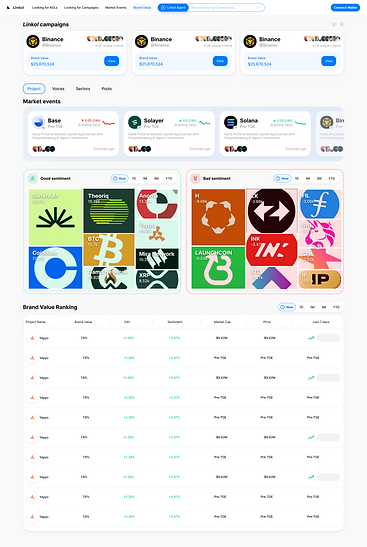
Landing Page

Simple Portal Structure
The initial layout derived from "vibe coding" was a minimalist entry point focused on basic navigation.

Limited Information Architecture
It featured a straightforward "What can I help with?" prompt with two primary buttons: "Post to Earn" and "Find the right KOL".
Minimal Brand Identity
The visual style was functional but lacked the established design system's depth, using generic placeholders for campaign and community data.
Dual-Sided Navigation
The final design features a sophisticated header with distinct paths for "Agent," "Predict," and "Post to Earn," allowing users to self-identify their role immediately.
Trust & Onboarding
The final design features a sophisticated header with distinct paths for "Agent," "Predict," and "Post to Earn," allowing users to self-identify their role immediately.
Final Version

Takeaways — Growth Beyond the Classroom
Working as an intern at VaporAviator Design Studio on the Linkol AI project was a transformative experience that redefined my understanding of the design process in a professional setting.
Professional Agility & Speed
I learned to design at a pace that is impossible to replicate in academic projects. In a studio environment, meeting client deadlines requires a balance of high-quality output and rapid iteration, teaching me how to "iterate wisely" without losing sight of the core user experience.
The Designer as a Strategic Curator
This project completely shifted my perspective on AI in the design workflow. Rather than seeing AI as a replacement for creativity, I learned to use it as a powerful communication bridge—taking raw "vibe coding" concepts from agents and refining them into logical, technically sound, and user-centric interfaces.
Mastering Complex Domains
Moving from zero knowledge to a designer capable of handling a niche, data-heavy field like crypto and creator valuations proved that my research methodology is effective. By using structured checklists and mentor-guided learning, I can rapidly bridge domain knowledge gaps to make informed design decisions.
Systemic Thinking through "UI Bricks"
I realized the immense value of building modular design systems early in a project. Creating a robust library of "UI bricks" (components) allowed me to scale the product across web, trading, and mobile platforms with total visual and functional consistency.
Collaborative Synergy
Communicating directly with the agents who paid for our service taught me the importance of stakeholder alignment. I learned how to ask the right follow-up questions to turn a client's "vibe" into a final version that matched both their business goals and our studio’s design standards.
bottom of page